Trex vs TimberTech vs Azek vs Deckorators: How Do You Choose?
There's something you should know about Two Teacher: we install all four major composite decking brands. While we might have our opinions about each line, we don't have a horse in this race, and we certainly don't earn more by steering you in any particular direction. So this comparison can be what most brand comparisons aren't: honest.
The short version is that, especially compared to where the composite decking space was at 10 or 15 years ago, there's no truly bad choice on this list. All four companies make durable boards that will outlast a wood deck in Minnesota by decades. The differences between those brands are real though, and which one is right for you depends on your project, your budget, your site, and your taste. Here at Two Teacher, we're all about educating our customers, so with that in mind, let's learn a bit more about deck boards:
What Actually Matters in a Composite Board
Ignore the marketing for a second. When we evaluate a board, we're looking at four things.
The Cap
Most modern composite boards are wrapped in a polymer shell that seals out moisture. How fully the board is capped, and how tough that cap is, drives stain, fade, scratch, and mold resistance.
The Core
Most composite cores blend wood fiber and plastic. PVC boards drop the wood entirely, and mineral-based cores swap in stone-polymer material. The core determines how the board handles moisture and how it moves with temperature.
The warranty
Every brand here backs its boards for decades, but the range of longevity still is pretty wide. Read what's actually covered: fade and stain guarantees matter more than the headline "will last x number of years".
Look and feel
Grain pattern, color depth, sheen, and how the surface feels underfoot on a July afternoon. Some brands make patterns that are much more convincing than others. This one you judge with your eyes and bare feet, not a spec sheet.
Trex
Trex created the composite category and remains the name most homeowners know. It's the brand that the most people walk in asking about, and that recognition is earned: broad color palette, consistent quality, wide availability, and a strong fade-and-stain warranty. Trex's lines run from budget-friendly to premium, so there's a Trex board at most price points. If you want a proven, recognizable choice with plenty of color options, Trex belongs on your shortlist.
The lineup runs in tiers: Enhance at the entry level, Select in the middle, and Transcend, Transcend Lineage and Signature at the top, where scratch resistance and color depth peak. Trex boards are made with up to 95 percent recycled material, which is a nice thing to stand on in more ways than one.


TimberTech
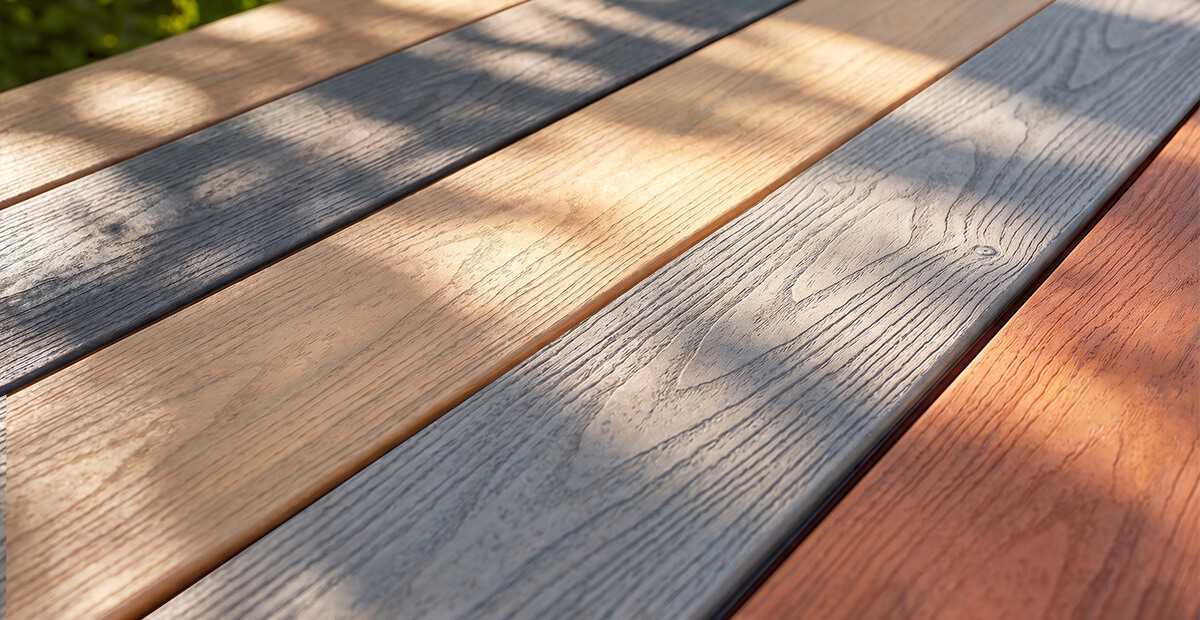
TimberTech's calling card is realism. Its capped composite boards carry some of the most convincing grain and color variation in the industry, to the point where visitors regularly can't tell a TimberTech deck isn't wood from a few feet away. Their lineup spans capped composite and PVC construction with strong moisture performance across the range. If the look of real hardwood without the upkeep is your priority, TimberTech makes a compelling case.
The composite side of the lineup covers 8 lines, with Prime at the most cost-effective end, all the way up to their Legacy line at the top, whose hand-scraped texture sets it apart. TimberTech caps its composite boards on all four sides, wrapping the core completely, and backs its range with fade and stain coverage up to 30 years depending on the line.
Azek (TimberTech Advanced PVC)
While Azek used to be it's own brand, it was recently acquired by Timbertech. Now, Azek is branded as TimberTech's "Advanced PVC Decking", and it takes a different approach: no wood fiber in the board at all. With nothing organic in the core, moisture has essentially nothing to work with, which is why these boards carry the strongest moisture and stain performance in this comparison and an exceptional warranty to match. Advanced PVC Decking sits at the premium end of the price range, and for high-exposure locations, lakeside decks, or buyers who want the best-performing board available, it earns it's place.
The Advanced PVC lines run Harvest, Landmark, and Vintage, and the warranty is the strongest paper in the category: a lifetime limited product warranty with 50-year fade and stain coverage. By TimberTech's own testing, PVC boards can also run meaningfully cooler underfoot than wood-fiber composite, a real consideration on a south-facing deck.


Deckorators
Deckorators forges its own path with a unique mineral-based composite called "Surestone" in its flagship lines. Replacing wood fiber with mineral material produces a board with impressive strength and very low expansion and contraction, plus excellent traction, wet or dry. That dimensional stability is worth real money in a climate that swings a hundred-plus degrees each year. Deckorators also pairs naturally with its own cable railing line if open sightlines are part of your plan. It's the brand people haven't heard of that keeps winning them over in person.
The mineral-based lines, Voyage and Summit, absorb almost no water at all (under five hundredths of a percent in testing), which is why Deckorators approves them for ground and even water contact, and why the structural warranty runs 50 years with 25-year stain and fade coverage alongside it.
The Numbers, Side by Side
Every figure below is the manufacturer's own claim; we'll help you read the fine print on any of them at the estimate visit.
| Trex | TimberTech Composite | AZEK/TimberTech Advanced PVC | Deckorators | |
|---|---|---|---|---|
| Core | Recycled wood fiber + plastic | Wood fiber + plastic | PVC, no wood fiber | Composite or Mineral-based composite |
| Capping | Three sides | Four sides on most lines | Full polymer board | Three sides |
| Headline warranty | 25-50yr limited + fade/stain | 25-30yr limited + fade/stain | Lifetime limited + 35-50yr fade/stain | 50-yr structural + 25-yr stain/fade |
| Known for | Recognition, color range, value tiers | Realistic grain | Moisture performance, cooler surface | Stability, traction, strength |
One honest note on warranty years, because this is where marketing does its best work. A bigger number isn't automatically better coverage! What matters is what counts as a defect, how fade is defined, whether coverage prorates down over time, and what the claim process asks of you. We've dealt with every brand, and know how they handle claims. If we visit to give you an estimate, we can answer any question you have about how they differ.
How Do They All Handle Minnesota Winters?
Starting with the basics, every board in this comparison is engineered for freeze-thaw, and none of them absorbs enough moisture for ice to damage the board itself. The differences are in the details. Boards with no organic content (PVC and mineral-based) expand and contract the least with temperature swings, and give mold nothing at all to eat, which matters on shaded or lakeside decks that stay relatively damp. And more textured caps hold traction when there's frost on the boards.
Winter care is the same for all four: use a plastic-edge shovel, run it parallel to the boards, sweep off light snow with a broom, and if you need ice melt, use calcium chloride and check your manufacturer's guidance first. No brand on this list asks more of you than that.
Which Composite Board Should You Pick?
The honest answer: it depends on the project, and the deciding factors are usually these.
- Budget tier. Each brand spans a range, and the ranges from different brands overlap. Entry-level composite and premium PVC are different price conversations regardless of the logo.
- Sun exposure. Full-south decks favor lighter colors and cooler-running boards. It's a different story if you have a shaded or north-facing exposure.
- Moisture. Lakeside or shaded, damp lots tilt the scales toward PVC or mineral-based cores.
- The color you fall in love with. Genuinely. Once performance needs are met, the board you'll be happiest with for 25 years is the one whose color and grain you love, and that exact color usually exists in one brand's line, not all four.
At the risk of being reductive, here's how things usually shake out. Want the name your future buyer will recognize, with the widest choice of colors and price tiers? Take a look at Trex. Want the deck that gets mistaken for real hardwood? Start with TimberTech. Building over water, in full sun, or just want the best-in-class maximum-performance board? Start with Azek. Kids, dogs, a shaded lot, or a thing for boards that never move? Think about Deckorators. Then let the actual samples settle the rest.
Brand Comparison FAQ
What About Cost Differences?
All four brands offer good-better-best lines, and the pricing spread within a brand is bigger than the spread between brands at the same tier. What moves your total more than the logo: the line you choose within the brand, the size of the deck, the railing system, and the structure underneath. We cover the full picture on our composite deck page, and we'll give you real numbers for your project when we see your actual deck in-person.
Let Us Help You Pick A Brand You'll Love!
Still undecided? That's what the estimate conversation is for. Contact us for an estimate or call (952) 472-5670, and we'll bring the samples.